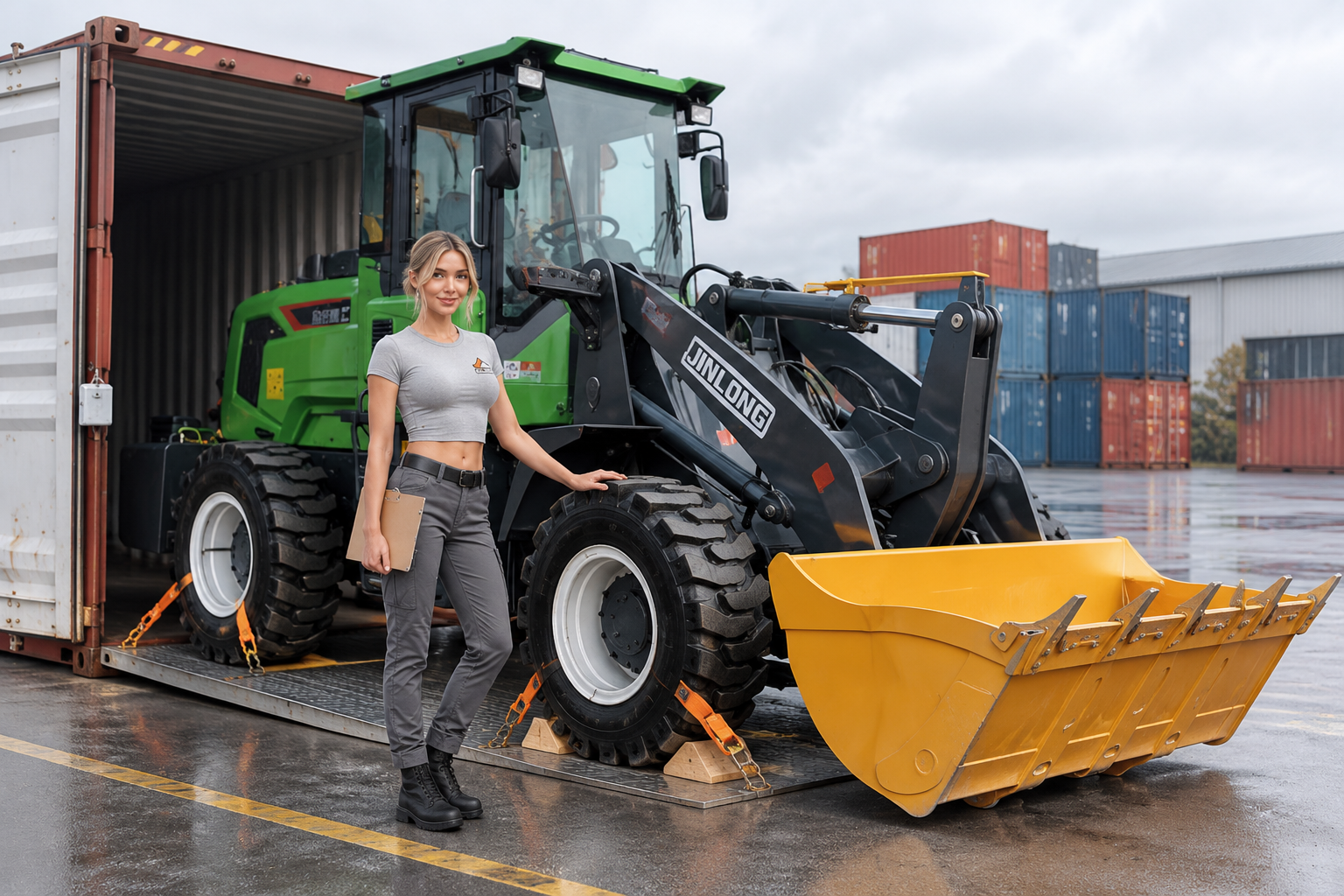
A factory price is the easiest number to compare and the least useful one to plan with. Between that number and a machine running on your site sit ocean freight, duty, inland transport, clearing fees, and a spare-parts plan. Importers who model those costs before signing the contract rarely get surprises; importers who model only the machine price usually do.
The risks in this category are predictable: transit damage, documents that do not match, and wear parts that take weeks to arrive. All three can be handled in advance.
This guide covers the sequence we see work in practice. Duty rates, required certificates and emission rules differ by country and change over time, so confirm each one with your own customs broker before you order — not from a general guide.
1. Build the landed cost before you compare suppliers
Ask every supplier to quote the same three layers separately, so offers stay comparable:
| Layer | What it contains | What to watch |
|---|---|---|
| Machine | Unit price, standard equipment, optional attachments | Whether the quoted configuration is the one in the photos |
| Logistics | Freight, insurance, port handling, inland haulage to your site | Which Incoterm the price is based on |
| Compliance and support | Duty and clearing costs, certificates, spare-parts kit, commissioning | Often omitted from a headline price entirely |
The delivery term changes what you are actually buying:
| Term | Where the seller's cost stops | What you arrange |
|---|---|---|
| EXW | Factory door | Pickup, export clearance, freight, import |
| FOB | Loaded on board at the port of loading | Freight, insurance, import |
| CIF | Freight and insurance to the named destination port | Unloading, clearance, inland haulage |
| DAP | Delivered to a named place, duty unpaid | Import clearance and duty |
Then add the local items nobody else can price for you: import duty on your tariff classification, clearing agent fees, port storage, last-mile transport with the right axle loads, and any registration or inspection required before the machine may work.
2. Fix the specification, then freeze it in writing
Most disputes trace back to a configuration that was described in words rather than documented. Before production starts, get a written specification sheet covering:
- Model, rated capacity and the load chart for the exact mast or boom configuration.
- Engine make, model and rated power, plus the emission or certification standard it meets for your market.
- Tyre type and size, ground clearance, and the drive configuration (2WD or 4WD).
- Voltage, plug and charger specification for electric models; cold-start or high-temperature requirements where relevant.
- Attachments included, and whether each ships with the machine or separately.
- Colour, branding, decal language, and the language of the operator manual.
State the requirement your market imposes and ask the factory to confirm in writing that the quoted engine and certificate package meet it. Jinlong's machines are built under ISO 9001 with CE certification and compliance to the EU Machinery Directive, and the factory supports OEM and ODM work — but the applicable standard for your country is confirmed case by case, against the configuration you order.
3. Choose the loading method that fits your order size
- One or two machines. A full container is rarely economical. Ask about consolidated shipping or less-than-container-load options, and confirm how the machine is protected alongside other cargo.
- A full container. Standard and high-cube boxes both work. Many models allow the cab, wheels, counterweight or attachment to be removed so more units fit in one container. That is SKD (semi-knocked-down) or CKD (completely-knocked-down) shipping. Ask which parts can be safely removed, how they are reinstalled at destination, and whether reassembly affects warranty.
- Oversized or heavy units. Flat rack, open-top or roll-on/roll-out arrangements suit machines that will not fit a standard box. Expect extra lashing and permits at destination.
Whatever the method, request the loading plan before shipment: units per container, tie-down and lashing points, and the sequence of disassembly. That single document settles most disputes about damage later.
4. Protect the machine for the voyage
Sea freight means salt air, condensation inside the container, and hard handling. Ask the supplier to confirm:
- Anti-rust treatment on exposed metal, and which coating is used.
- Chassis secured with lashing and blocking; loose items separately fixed.
- Waterproof wrapping on electrical connectors, the control box and the display.
- The fluid state the manufacturer recommends for shipping — drained, or partially filled.
- Photographs of the packed machine before the container is sealed, plus the seal number.
Keep the packing photos in the order file. They are the baseline for any insurance claim.
5. Get the documents consistent, not just complete
Your clearing agent will normally require the bill of lading, commercial invoice, packing list, certificate of origin (plus any preferential-origin form your destination accepts), and the product certificates that apply to this machine type.
The delays we see are rarely about missing paperwork. They come from inconsistency:
- The machine description, model and quantity match exactly across invoice, packing list and bill of lading.
- The tariff classification is agreed with your broker before shipping, not invented at the border.
- Serial numbers and chassis numbers appear on the packing list in the form your registration authority expects.
- Certificate holder, importer name and address are the ones your market requires.
- Originals, copies and file counts match what the port asks for.
Send your broker the draft document set before the vessel departs. Correcting a document in transit is far cheaper than correcting one on the quay.
6. Inspect on arrival within the claim window
Agree the acceptance process before the machine ships, while you still have leverage:
- Video or photo inspection from the factory before packing, on the finished machine.
- Independent pre-shipment inspection if your order size justifies it.
- Container opened on level ground with witnesses present.
- A written arrival checklist: body and boom damage, glass, tyre condition, fluid levels, battery state, error codes, functions under load.
- Photographs taken before anything is cleaned or repaired.
Insurance claims are time-limited. Know the number of days your policy allows for noting damage, and check the container exterior and seals before the haulage truck leaves the port.
7. Order the wear parts with the machine, not after it
A machine spends far more hours in service than in transit, and downtime is usually a parts problem rather than a breakdown. A sensible starter kit, agreed with the factory against your specific model and serial configuration, normally covers:
- Engine, hydraulic, fuel and air filters.
- Hydraulic hoses for the most-used circuits, plus seals and common gaskets.
- Wear items: teeth or cutting edges, lights, bulbs, wiper and mirror parts.
- Filters and service items for the first scheduled maintenance.
Ask two further questions: the lead time for anything outside that list, and which parts are locally available in your market. Also confirm what support comes with the machine — Jinlong lists installation and commissioning guidance, 24-hour online technical support and a dedicated spare-parts team, with delivery within 7–45 days depending on model and order size. Verify which of these apply to your model and destination.
8. Compare quotations like for like
Request the same ten items from every supplier, in writing: full specification sheet and load chart; mast and transport dimensions; engine and transmission details; tyre specification and ground clearance; standard equipment and optional attachments; certificates applicable to your destination; warranty coverage and the claim procedure; spare-parts list and recommended service kit; packing and shipping method; and the delivery term with unit count per container.
Two quotations that look similar often differ on residual capacity at height, on mast type, on tyre size and on what is included in the "standard" package. Those differences are worth more than a small gap in price.
If you are still deciding between machine categories, our comparison of wheel loader and rough-terrain forklift explains which duty cycle suits each one. For forklift specification details, see the rough terrain forklift buying guide.
9. Start with a request the factory can price
A first reply is useful only if the request is specific. Send:
- Machine type, or the duty cycle it must cover — material, weight, lift height, distance, hours per day.
- Quantity, and whether this is a trial unit or a fleet order.
- Destination port or delivery address, and your preferred delivery term.
- The certificates, emission standard and configuration your market requires.
- Your target budget range and expected commissioning date, if you have one.
You can describe your job through Mia, Jinlong's AI-generated virtual brand ambassador, from the chat button on the site or the Meet Mia page. Mia helps organise your operating details into a clear enquiry. Mia is not a human sales representative or engineer: final machine configuration, compliance for your country, the shipping plan and the quotation are confirmed by the Jinlong team.
Jinlong's parent company was founded in 1996 and has more than 30 years of construction machinery manufacturing behind an 88,000 m² facility with six production lines and annual output of 50,000 units; machines are exported to more than 100 countries. Browse the range on the product overview page.
Specifications, certificates and service terms mentioned here are indicative. The controlling values are the ones on the current product page and the ones confirmed in writing for your exact configuration and destination.