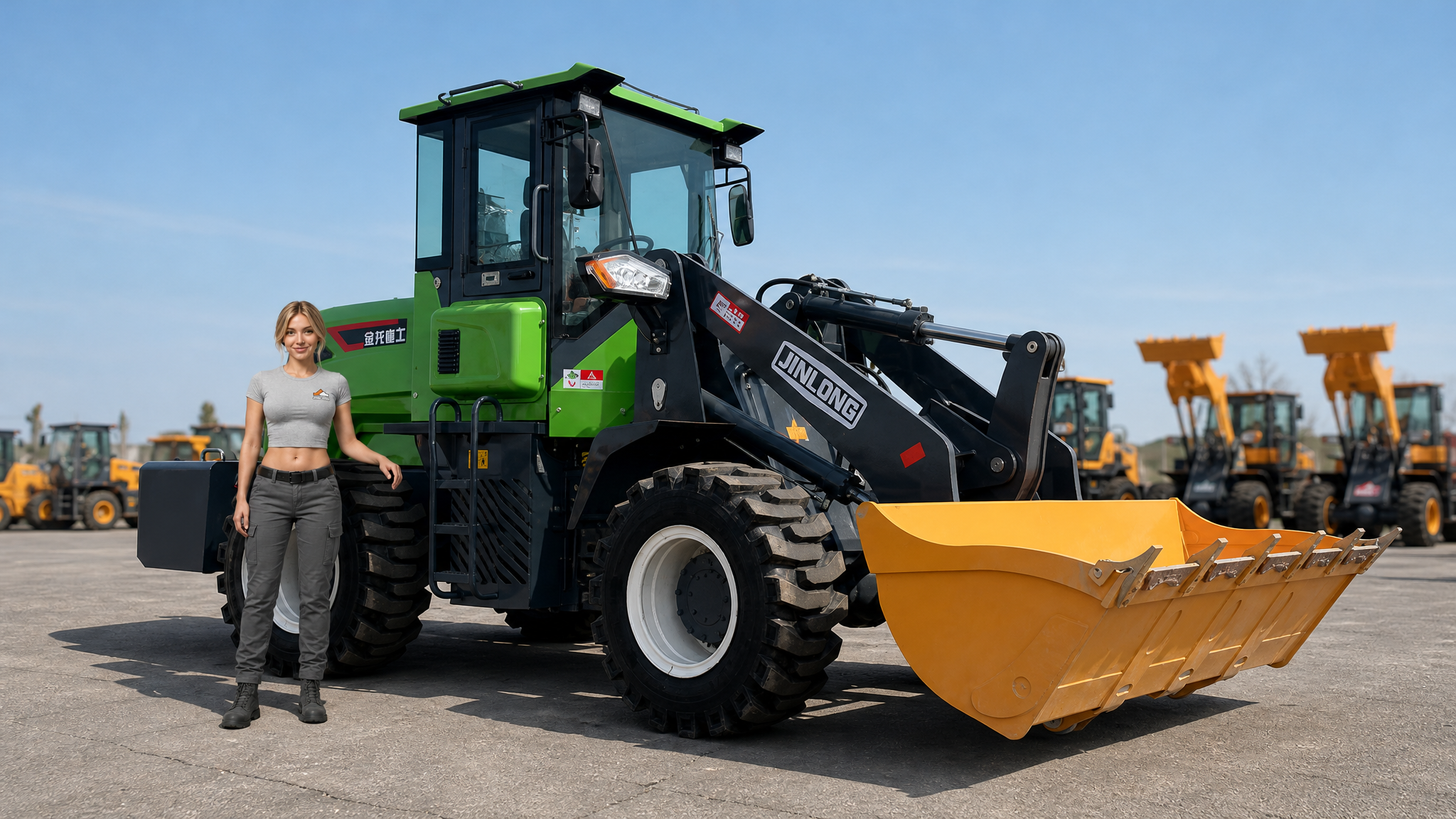
Two machines, one yard, and a decision that affects the next five years of your operating cost. Buyers comparing a wheel loader with a rough-terrain forklift usually start with the same question: which one will actually move our material?
Neither machine is better in general. A wheel loader and a rough-terrain forklift solve different problems, and the right answer depends on three things: what you move, how far you move it, and what the ground looks like underneath.
This guide gives you a practical way to decide, using the specifications buyers actually compare.
The material handling dilemma
Most buyers who end up comparing these two machines share a specific situation. They handle a mix of goods — bulk material in one corner of the site, palletized or boxed loads in another — and they can only justify one machine in the first purchase.
The mistake is to compare them on lifting capacity alone. A three-ton loader and a three-ton forklift are not interchangeable, even though the numbers look similar. One is built to scoop, carry, and dump loose material. The other is built to place a stable load precisely at height.
Quick comparison
| Factor | 4x4 diesel wheel loader | Rough-terrain forklift |
|---|---|---|
| Main job | Scooping, carrying, and dumping loose material | Lifting and stacking palletized or boxed goods |
| Typical material | Gravel, sand, coal, soil, feed, logs, sugarcane | Pallets, cartons, drums, building materials, timber |
| Load interface | Bucket, log grapple, pallet forks, rock bucket | Forks, hydraulic side shifter |
| Working motion | Ground-level dig, carry, tip | Vertical lift to racking or stack height |
| Lift height | Dump height depends on configuration (the agricultural log loader is listed at 3,000–5,000 mm) | 3 m, 3.5 m, or 4 m configurations |
| Ground | Uneven, unpaved, muddy, sloped | Unpaved yards, orchards, rough sites |
| Attachment switching | Frequent, multi-purpose | Limited, load-specific |
The table shows the real dividing line: it is not weight, it is the shape of the work. Horizontal movement of loose material belongs to the loader. Vertical placement of a stable load belongs to the forklift.
When a wheel loader is the clear choice
A wheel loader makes sense when most of your working hours go into loose material. If you are filling trucks from a stockpile, moving gravel around a quarry, clearing soil, or feeding a mixing plant, the bucket is the fastest tool for the job — and no forklift can substitute for it.
Look at a wheel loader when:
- Your daily work is scooping and carrying bulk material over short distances, usually under 200 metres per cycle.
- You need to switch between a bucket, a log grapple, pallet forks, or a rock bucket on the same machine.
- The site has slopes, soft ground, or no paved surface at all.
- Your material arrives loose and leaves loose — it never sits on a pallet.
Jinlong's 4x4 diesel tractor loaders are offered in rated-load configurations from 0.6 to 3 tons, with a fully hydraulic system and Yunnei engine options. The 1.5-ton model in this range (JL15) is listed at an operating weight of 5,200 kg with a 1.2 m³ bucket. Dimensions and weight differ by model, so check the model table on the product page before comparing sites. Across the range, bucket capacity runs from 0.8 to 2.0 m³ depending on the configuration, material density and cycle time.
That last point matters more than most buyers expect. Bucket capacity is not a fixed number you pick once. Loose dry sand and wet gravel behave differently in the same bucket, and a bucket sized for sand will be over-loaded on dense material. Tell the team what you actually move, not just the tonnage you want to see on the spec sheet.
When a rough-terrain forklift is hard to replace
A forklift is the better tool when your goods arrive on pallets or in boxes and must be placed at height. Warehouses, timber yards, farm storage, and equipment workshops all fit this pattern.
Look at a forklift when:
- Your loads are palletized and must be stacked or placed onto racking.
- You need lift heights above what a bucket can reach — 3 m, 3.5 m, or 4 m depending on the mast configuration.
- You must travel over unpaved ground but still need precise fork placement at the top of the lift.
- Your loads are fragile, stacked, or need to stay level during transport.
Jinlong's rough-terrain forklift range covers rated lifting capacities from 3 to 7 tons with 2WD or 4WD options, diesel power, Yunnei engine options, and CE and ISO certification. Available lifting heights are 3 m, 3.5 m, and 4 m.
A note on the "rough terrain" part: this is not marketing language. A standard warehouse forklift on gravel will sink, lose traction, and put stress on the mast that it was never designed for. The rough-terrain version exists because the ground, not the load, is the limiting factor.
Total cost of ownership
Purchase price is only the first number. The second number — the one that decides whether the machine was a good buy — is what it costs to keep running.
Fuel and duty cycle. A loader that spends its day digging and carrying runs a different fuel profile from a forklift making repeated short lifts. Ask for fuel consumption at your expected duty cycle, not at a nominal rating.
Tyres. Rough ground wears tyres faster on both machines, but the wear pattern differs. Loaders wear from constant steering and load transfer; forklifts wear from tight turning under load. Price a replacement set before you buy.
Hydraulics and mast. The mast is the most stressed assembly on a forklift. Ask which seals, hoses, and chains are routine service items, and keep a small stock on site.
Attachments. Adding a grapple or a side shifter later usually costs more than ordering it with the machine, and lead time is longer.
Parts availability. Ask which filters, seals, and hoses are common across the range. A machine that shares parts with the rest of your fleet is cheaper to keep running than one with a unique specification.
Three steps to finalize your choice
Step 1: Identify the material that takes 80% of your time. Not the material you handle occasionally — the one that fills your working day. Loose material points to a wheel loader. Pallets and boxes point to a forklift.
Step 2: Measure the site. Note the steepest slope you must climb loaded, the narrowest passage the machine must pass, and the surface type. These three numbers eliminate more wrong choices than any specification comparison.
Step 3: Describe the job and get a configuration recommendation. This is where most buyers stall, because the specification sheet does not know your site. Meet Mia, Jinlong's AI-generated virtual brand ambassador, can take your working conditions — material, ground, lift height, daily volume — and help you narrow the options before a formal quotation. The Jinlong engineering and sales team then confirms the final machine configuration, compliance requirements for your destination country, and delivery terms.
You can start here: Meet Mia.
If you already know what you need
Skip the comparison. Bring four things to the team and you will get a usable first recommendation:
- Material type and density
- Daily volume and cycle distance
- The steepest slope and the narrowest passage on site
- Destination country
That is enough to move from a category decision to a specific configuration.
Related equipment
- 4x4 diesel wheel loader — 0.6–3 ton rated load, 4x4, fully hydraulic
- Rough-terrain forklift, 2WD/4WD — 3–7 ton capacity, 3/3.5/4 m lift height
- Agricultural log loader — 1.2 m³ bucket, farm and forestry work
- All products
Mia is Jinlong's AI-generated virtual brand ambassador, not a human salesperson or engineer. She helps buyers describe their working conditions and narrow the equipment category. Final machine configuration, compliance for the destination country, pricing, and delivery terms are confirmed by the Jinlong engineering and sales team.